God of War and masculinity go hand in hand as the series show us how Kratos transforms from a monster into a father. See how God of War characters reshape manhood.
When we think of the God of War franchise, the first thing that comes into our mind is blood, chaos and our anti-hero Kratos screaming and tearing gods apart. Well, that is the Greek saga, a brutal and unforgettable era where masculinity was all about dominance, rage, and revenge. But everything changed when Santa Monica Studio released God of War (2018), bringing Kratos into Norse mythology. Suddenly, this god of rage became a father, and the franchise shifted from pure action to deep storytelling. As a fan, I can say the first Norse game felt like a shock in the best way possible. It was still violent and cinematic, but now it had heart.
Then came God of War Ragnarök, a bigger and more ambitious sequel. This time, the stakes were higher, the characters richer, and the father-son bond was explored even in a deeper way. While the Greek games gave us endless action, these two Norse entries gave us something more important: a story about family, trauma, and what it means to be a man. In fact, no recent franchise has explored any theme as deeply as God of War and masculinity. The transformation of Kratos, Atreus, and other God of War characters shows how strength is not only about rage, but about empathy, honesty, and growth.
Let’s break down how God of War and masculinity come together through some of the series’ most powerful lessons.
A Lesson in Survival, Rather Than Cruelty
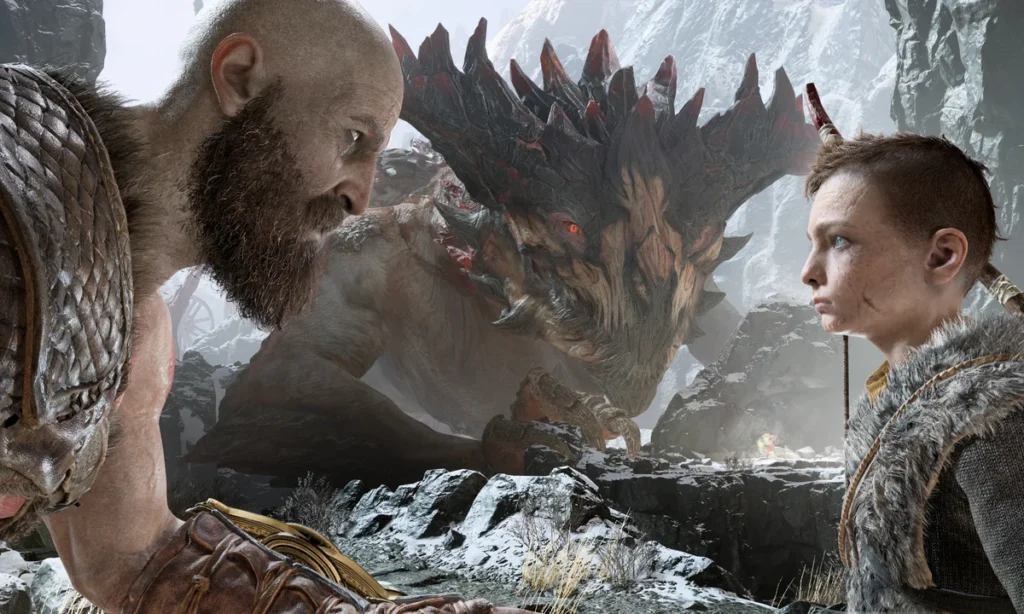
The very first hunt in God of War (2018) is unforgettable. Atreus, nervous and inexperienced, has to kill a deer while Kratos watches. To many players, it felt unnecessarily cruel. But this is where God of War and masculinity set its tone. Life in the Norse wilderness is harsh. There is no farming, no fruit, no gentle way of living. To survive, you must hunt. By pushing Atreus to face this reality, Kratos is not teaching cruelty. He is teaching responsibility.
This is what makes the scene powerful. God of War characters remind us that masculinity is not about enjoying violence but about making difficult decisions for survival and family. It is about accepting responsibility even when it hurts.

Fatherhood as a Test of Strength
In earlier games, Kratos proved his strength by killing gods and monsters. But in the Norse saga, fatherhood becomes the true test. Here we see the heart of God of War and masculinity. Strength is not about endless rage, but about guiding the next generation.
Kratos struggles with this new role. He is harsh, stoic, and often frustratingly cold. Yet through his actions, we see a man trying to change. God of War no longer glorifies brute force alone. It shows that the strongest thing a man can do is protect his child, not only from enemies but from repeating his own mistakes.
Teaching Atreus: Breaking Generational Trauma
One of the most important themes in God of War and masculinity is breaking cycles. Kratos was raised in violence, used and betrayed by the gods of Olympus, and trapped in endless rage. He knows what that path leads to. His biggest fear is that Atreus will inherit the same curse.
This is why he hides the truth about Atreus’s godhood, and why he constantly tells him to control his anger. It is not about being strict for the sake of power. It is about teaching his son not to become the monster he once was. This is how God of War characters show us that masculinity is not only about strength but about the courage to break destructive traditions. A man who refuses to pass down his trauma is stronger than one who can lift a mountain.
God of War characters show embracing Empathy as a Weapon
For a franchise built on rage, it is surprising how much empathy becomes central in the Norse games. In God of War and masculinity, Kratos learns that sometimes sparing a life shows more strength than ending it. His empathy goes far beyond supporting Atreus despite his mistakes. We see this when he holds back against Baldur, when he shows kindness to Freya despite her hatred over killing Baldur, which was totally irrational since Baldur had not only tried to kill Kratos but also her.
This is a huge shift from the older games. The Greek Kratos would have slaughtered anyone like Freya in his path without a second thought. The Norse Kratos pauses, thinks, and even feels. God of War characters prove that empathy is not weakness. In fact, it is one of the most powerful tools a warrior can wield.

The Burden of the Past: Learning to Be More Than a Monster
Still, Kratos can never fully escape his past. His memories of Greece haunt him, and every scar reminds him of the blood he spilled. This weight is central to God of War and masculinity. Kratos is not pretending he was never a monster. He is trying to prove that a man can change, even if his past is unforgivable.
This is one of the most inspiring lessons of the series. God of War reminds us that masculinity is not about being flawless. It is about carrying your past, learning from it, and refusing to let it define who you are today. In the eyes of Atreus, Kratos does not need to be a perfect hero. He just needs to be better than the monster he once was.
The message of God of War Franchise Lies in Strength Beyond Rage
The Norse saga of God of War gave fans something far greater than cinematic combat. It gave us a meditation on what it means to be a man in a broken world. By exploring God of War and masculinity, we see that strength is not about endless violence. It is about survival, fatherhood, empathy, and the courage to break cycles of trauma.
God of War characters like Kratos and Atreus show us that masculinity can be redefined. It is not about being feared, but about being responsible. It is not about rage, but about restraint. And most importantly, it is about passing on something better to the next generation.
Even universities are now exploring these themes, with research like The Evolution of Masculinity and Fatherhood in God of War: Ragnarök published in the Kennesaw Journal of Undergraduate Research.